

Xiamen – Tea, Tulou, and Torrential Rain
After the misty mountains of Huangshan, we continued southeast to Xiamen, a vibrant coastal city in Fujian Province. If Xi'an is known for its ancient history and Guilin for its breathtaking scenery, Xiamen impressed us with its energy. As one of China's first Special Economic Zones, it prospered through international trade while preserving reminders of its colonial past. Modern skyscrapers stand alongside elegant European-era mansions, giving the city a character unlike anywhere else we visited in China.
Located on the Taiwan Strait, Xiamen has long been China's window to the sea. More than five million people live in the metropolitan area, and Kinmen, one of Taiwan's islands, lies only about ten kilometers offshore—a fascinating reminder that geography and politics are often separated by only a narrow stretch of water.
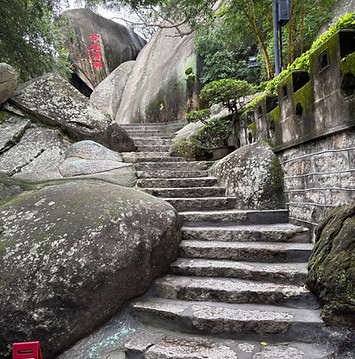
Rain had followed us from Guilin and Huangshan, and it wasn't finished yet. We took the ferry to Gulangyu Island under gray skies and steady rain before climbing to one of the island's highest viewpoints. The soggy walk was rewarded with sweeping views of Xiamen, the island's beautiful colonial architecture, and the Taiwan-controlled islands in the distance. Sometimes the best views come with wet shoes.
Fujian is one of China's great tea-producing regions. In fact, the English word tea is believed to have originated from the local Hokkien pronunciation, carried around the world by traders sailing from these ports centuries ago.
At lunch, our waiter insisted we try one of the region's specialties. He patiently demonstrated how to build what we could only describe as a Chinese burrito. Using chopsticks, he spread a paper-thin rice pancake on the plate, added a variety of sauces, then layered it with bamboo shoots, chicken, shrimp, herbs, and sprouts before rolling it into a surprisingly delicious handheld meal. It was unlike anything we'd tasted elsewhere in China.


Our excursion into the countryside took us to visit the remarkable Hakka Tulou villages. Although most are no longer inhabited, these centuries-old packed-earth buildings remain remarkably well preserved. Built by the Hakka people as circular communities, each family occupied its own multi-level apartment while sharing the large central courtyard for cooking, gatherings, and daily life. Massive outer walls—some up to six feet thick—with very few exterior windows provided protection from bandits and rival clans, while nearly every apartment had windows facing the central courtyard, reinforcing the communal design.
Today, only an occasional resident remains, and a few sell souvenirs to visitors. In some of the abandoned homes, pots, pans, furniture, and bedding have been left behind, as though the families had simply packed up and moved on. On a gray, drizzly day, it was interesting to wander through these unique round structures and imagine them once bustling with life—children playing in the courtyard, neighbors chatting from wooden balconies, and generations of families living together under one roof. Today, the tulou stand as remarkable reminders of a disappearing way of life, their residents having traded communal living for the comforts and conveniences of modern apartments.
One stop remained before leaving China—a city where centuries of history meet one of the most futuristic skylines on earth.


Shanghai – A Fitting Finale
Shanghai provided a fitting finale to our month in China.
Home to more than twenty-five million people, Shanghai is China's financial and commercial powerhouse. We began our visit strolling along the Bund, Shanghai's famous 1.5-kilometer waterfront promenade, umbrellas in hand as a steady rain fell along the Huangpu River.
From there, we could see nearly two centuries of history at once. Behind us stood the grand European-style buildings constructed during the foreign concession era. Walking along the Bund was like a who's who of early-1900s architecture, with famous landmarks including the HSBC Building, the Custom House, the Peace Hotel, and the former Bank of China headquarters.
Across the river lay the Pudong district, where a dense cluster of skyscrapers—including Shanghai Tower and the distinctive "bottle opener" Shanghai World Financial Center—showcases China's remarkable economic transformation.
Unfortunately, the low clouds and rain that had followed us across much of southern China had one last surprise. Shanghai Tower disappeared into the fog, making a trip to the observation deck pointless. Even so, watching the skyline emerge and disappear through the mist gave the city a dramatic atmosphere all its own.
The city itself was equally impressive. Electric scooters seemed to be everywhere, quietly weaving through the streets, and more than 40 percent of the cars in Shanghai—and in many other major Chinese cities—are electric. The widespread adoption of electric vehicles has contributed to a tremendous improvement in air quality across much of China. Having visited before, the difference was noticeable and one of the country's most impressive transformations.
We enjoyed another excellent dim sum lunch before visiting a traditional silk factory. Watching silkworm cocoons transformed into delicate strands of silk—and eventually into scarves, quilts, and clothing—gave us a new appreciation for one of China's oldest industries. Seeing the entire process was fascinating. It was remarkable that such a beautiful and valuable industry could begin with the humble silkworm caterpillar.
Our final stop was the Jade Buddha Temple, built to house two remarkable white jade Buddha statues brought from Myanmar in the late 1800s. A Chinese monk commissioned the statues from Burmese craftsmen during a pilgrimage and left two of them in Shanghai, where the temple was later built in their honor. The larger seated Buddha, carved from a single piece of white jade and adorned with precious stones, is especially striking.
Despite the many visitors, the temple felt remarkably peaceful. Monks quietly chanted as worshippers lit incense and offered prayers, creating a calm, reflective atmosphere in the middle of one of the world's largest and busiest cities. Surrounded by Shanghai's modern skyline, it was a fitting reminder of one of the themes we had encountered throughout our month in China: ancient traditions and remarkable modernization existing comfortably side by side.
Reflecting on our month in China, we found it to be far more modern, diverse, welcoming, and beautiful than we had expected. From imperial palaces and ancient villages to futuristic skylines and mist-covered mountains, each region revealed a different side of the country and challenged many of our preconceptions.
We left with wonderful memories and a much deeper appreciation for China's history, culture, and people. It was a fascinating journey through a country where ancient traditions and remarkable modernization exist side by side—a place that continually surprised us from beginning to end.


